

formerlyRobotics and Intelligent Systems Labat CityUHK
Robots that don't just fly, walk, or jump. They move seamlessly between the three, drawing on how animals combine locomotion modes rather than specializing in just one.
Powered by Bidirectional Thrusters
A 220-gram hopping robot that carries payloads up to nine times its own weight, closing the gap between high-payload ground robots and agile aerial platforms. Bidirectional thrusters manage energy through each hop, while a compressed neural network keeps control running in real time onboard.
220 g
robot mass
0 g
max payload
0x
payload ratio
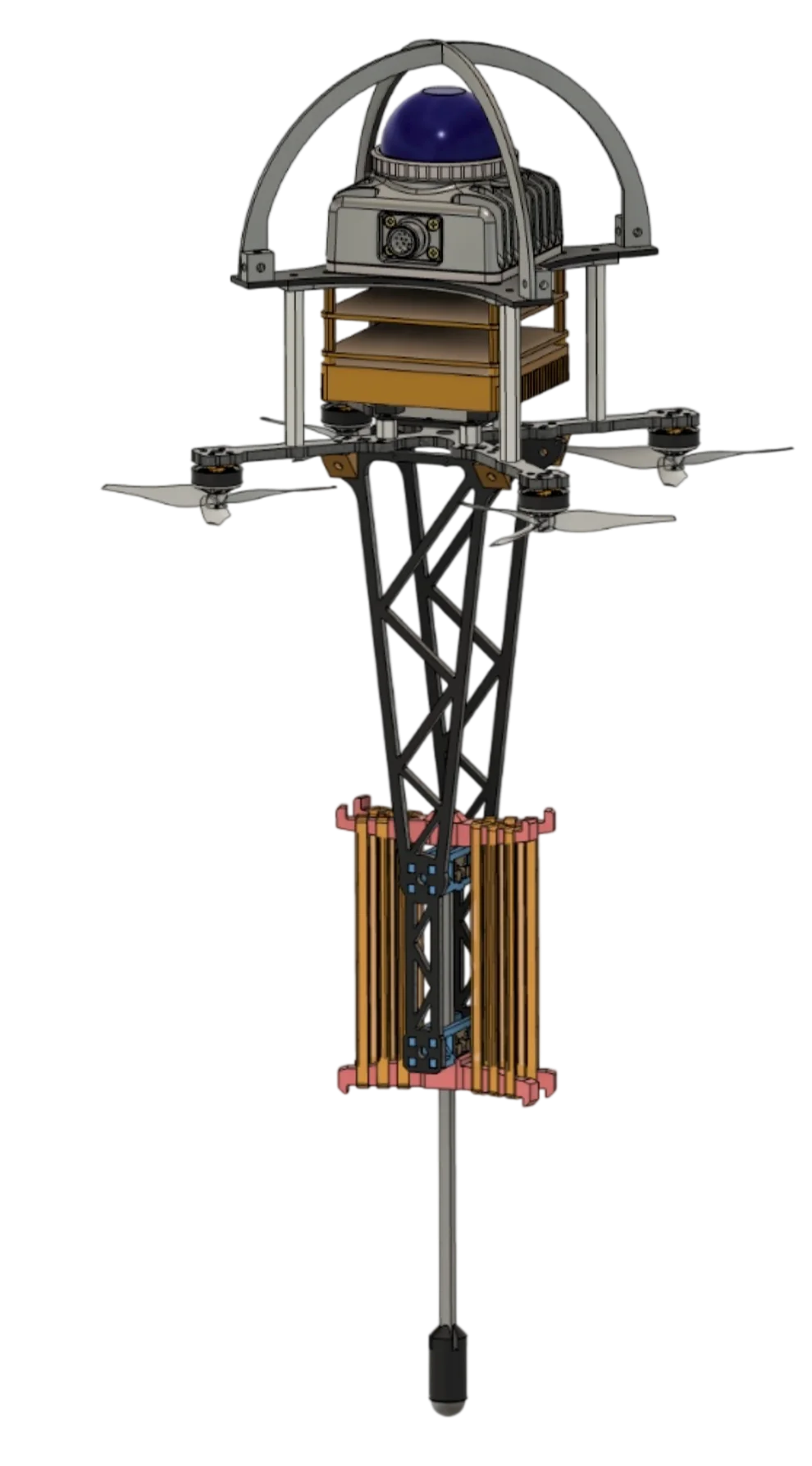
A nano quadcopter with a passive telescopic leg that seamlessly switches between flight and hopping, reaching 2.38 m/s vertical hopping speed.
Science Robotics, 2024 →A subgram flapping-wing robot that hops continuously on a spring leg, cutting power use 64% versus flight while carrying 10x the payload.
Science Advances, 2025 →A quadrotor with a passively reconfigurable rolling cage that locks to the body for precise rolling and turning, extending ground range up to 15x over flight.
IEEE Robotics and Automation Letters, 2023 →Mechanical design and control worked out together, not separately: passive dynamics and adaptive control that keep robots stable and efficient without brute-force computation.
One Cable, Three Flight Modes
Two bicopters connected by a single cable that reconfigures in mid-air: flying independently with the tether slack, tensioning it to coordinate as a tethered pair, or reeling it in to dock into one rigid quadcopter. The same cable doubles as the platform's only end effector, exerting forces and torques on the environment without any extra grippers or actuators.
Dynamic perching via swing motion
One Foot, All Terrains
A compliant spherical joint lets the sole self-align to the ground on contact, while embedded steel spines add grip on loose or slippery surfaces. Two variants share that same joint: a smooth planar sole, and a spined version for extra bite on ice and gravel.
Advanced Intelligent Systems, In Press →
Insects and other small animals already solved the challenge of agile, efficient motion at small scale. We study how, then build robots the same way.
Efficient Hovering Flight, Passively Stable
A 35.1-gram aircraft that hovers by powered gyration, like a maple seed spinning as it falls. Oversized revolving wings are shaped for passive attitude stability, so the drone stays upright without fast feedback control, while cutting power consumption in half compared to benchmark multirotors.
35.1 g
aircraft mass
0x
less power than multirotors
0 min
flight time
Sensing Without Seeing


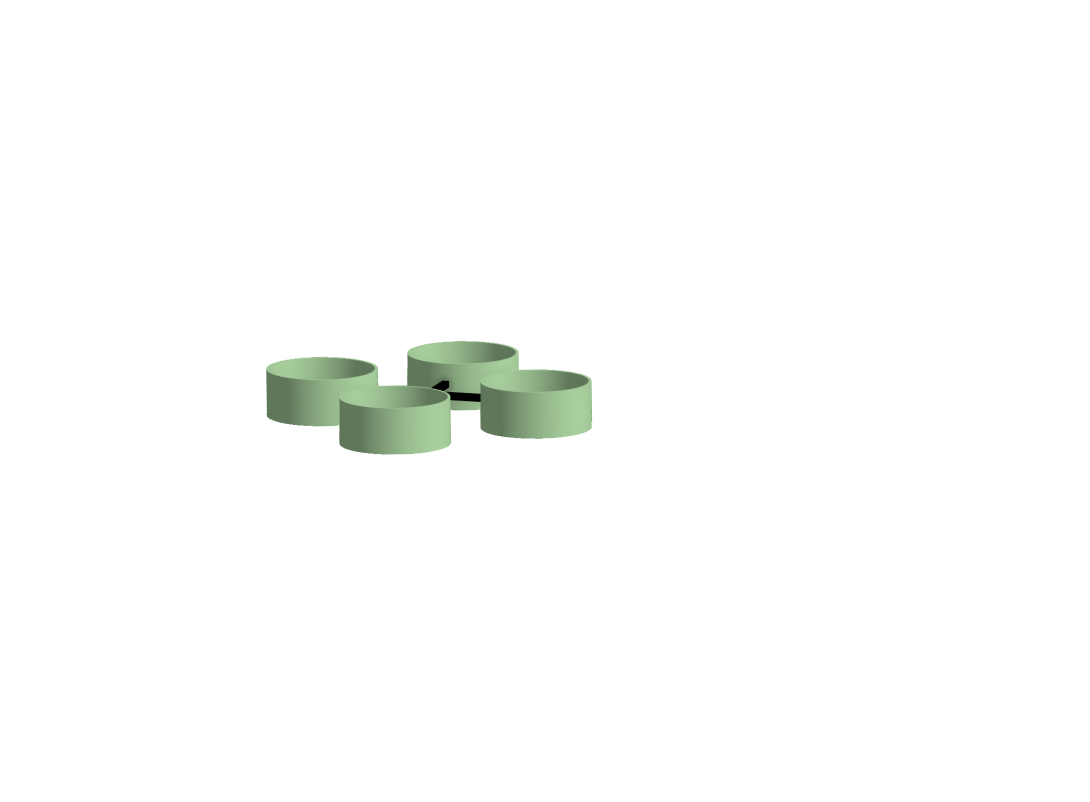
Flies in, senses the wall through its own propeller wash, then glides along it
Mosquitoes and other flying insects can tell a wall is near without ever looking at it: air reflected off the surface disturbs the flow around their wings, a cue felt well before it could be seen. This quadcopter borrows the trick. Its own propeller wash changes measurably as it nears any surface, glass and mirrors included, giving it a contactless way to react and steer clear with no camera in the loop.
RS313
Dept. of Mechanical & Industrial Engineering
University of Toronto
5 King's College Rd, Toronto, ON M5S 3G8
Y1516, Yeung Kin Man Academic Building
City University of Hong Kong
83 Tat Chee Ave, Kowloon Tong, Hong Kong